- Market, limit and stop orders against real live prices — priced and timestamped by us, never typed in by you.
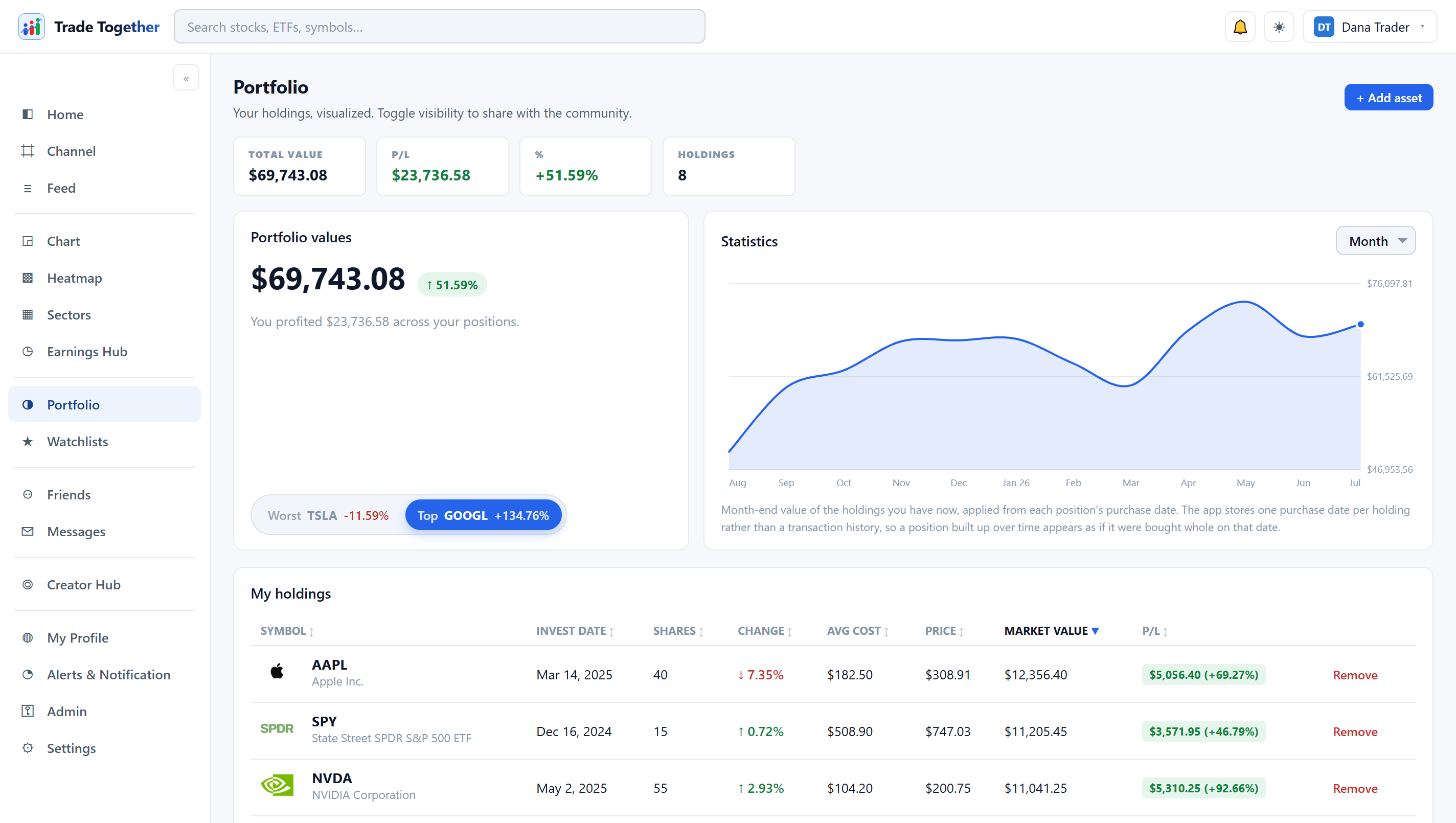
- A portfolio that keeps score — holdings, cost basis and profit or loss, tracked over time.
- Private by default, public with one switch if you want your record open to others.
What is paper trading?
Paper trading is practicing trades with simulated money instead of real money. You place the same kinds of orders you would in a live account, then track how they do — with nothing actually at stake.
The name is old. Before apps, people wrote hypothetical trades on paper, checked prices later, and tallied the results. The tool changed; the point didn't. You're rehearsing the process — picking a ticker, deciding size, placing an order, managing the position, reviewing what happened — so the mechanics feel familiar before real money is involved. On Trade Together this is exactly what happens under the hood: your orders are simulated, your holdings are tracked, and no real money is ever executed. Same muscle memory, zero downside.
How does paper trading work?
You start with a virtual balance, place simulated buy and sell orders on real tickers at real market prices, and the platform keeps score. It tracks your holdings, your cost basis, and your profit or loss over time — the way a real account statement would, minus the real money.
Here's the loop on Trade Together. You browse US equities and ETFs, read the financials and stock data, pull up a chart or the heatmap, and decide what you want to do. You place a simulated order. Your portfolio updates. From there you watch it, add to it, trim it, or close it — and every move is recorded so you can look back and see what actually worked. Because the trading is simulated, you can try an idea you're unsure about without paying for the lesson in real dollars. Prices are real; the risk isn't. That's the trade-off that makes paper trading useful for learning, and it's the same trade-off that gives it limits — more on that below.
Is paper trading free?
On Trade Together, yes. Paper trading is 100% free and built straight into the platform — no paywall, no trial clock, no credit card.
We mean free for everyone. The simulator, the charts, the heatmap, the financials, the earnings and news, and the community all sit in one place at no cost. A lot of simulators either charge a subscription, cap how many trades you can log, or lock the useful data behind an upgrade. That's not us. You get the tools and the practice environment together, and you keep them. Free. For everyone.
How do you start paper trading?
Create a free account, then place simulated orders on US stocks and ETFs and track your portfolio as it moves. That's the entire on-ramp — no funding step, no broker application, no minimum balance.
Step by step:
- Create a free account. No credit card. Takes a minute.
- Place simulated orders. Pick a US stock or ETF, choose your size, and buy or sell. It's simulated, so a mistake costs you nothing but a note-to-self.
- Track your portfolio. Watch holdings, cost basis, and profit or loss update over time. Reviewing your own history is where the learning compounds.
- Make it public or keep it private. Keep your portfolio to yourself while you find your feet, or make it public so others can see how you actually trade.
That last part is the Trade Together twist. You're not practicing alone in a sealed sandbox. Creators here open their portfolios and results, so you can follow how other people approach the same market — and judge them on results, not follower counts. Plans, not promises. None of it is investment advice; it's people learning out loud.
Does paper trading actually help you get better — and what are its limits?
Yes, within limits. Paper trading genuinely helps you build a repeatable process and get comfortable with orders, charts, position tracking, and reviewing your own decisions — all without risking money. But it is not a perfect mirror of live trading, and pretending otherwise would be dishonest.
What it's good for: reps. You learn where the buttons are, how an order behaves, how a position feels day to day, and whether your idea survives contact with a moving market. FINRA's own tips for new investors push the same fundamentals a simulator lets you rehearse — set goals, understand your risk tolerance, mind your costs, and educate yourself before you commit real money. Paper trading is a low-stakes place to practice exactly that.
Now the limits, plainly:
- The emotions are different. When the money isn't real, the fear and greed are muted. Holding a losing position hurts less on paper, so you may act more disciplined than you truly are. Real money changes behavior.
- Fills are idealized. A simulator tends to fill you at a clean price. In a live market a market order guarantees execution but not the execution price — as the SEC notes, the last-traded price is not necessarily the price you get. Real slippage, spreads, and partial fills don't fully show up in a simulation.
- No real consequences. You can restart, ignore a blown-up position, or take size you'd never take live. Useful for experimenting — but it can teach habits that don't hold up when it counts.
This honesty is the point. Paper trading builds the skeleton — process, familiarity, a review habit. It can't hand you the real-money psychology. Use it for what it's good at, and go in knowing what it can't do. Not investment advice.
What's the difference between paper trading and trading with real money?
The core difference is what's at stake. Paper trading uses simulated money, so nothing is on the line, the emotions are lighter, and fills are clean; real-money trading risks actual capital, adds real slippage and fees, and — as the SEC bluntly puts it about stocks — you can lose money.
Here's the honest side-by-side.
| Paper trading vs real-money trading | Paper trading | Real-money trading |
|---|---|---|
| Money at risk | None — simulated only | Your actual capital |
| Emotions | Muted; easier to stay disciplined | Real fear and greed affect decisions |
| Fills / slippage | Idealized, clean fills | Real spreads, slippage, partial fills |
| What it's good for | Learning mechanics, building process | Actual returns and real consequences |
| Cost | Free on Trade Together | Capital, plus fees and the risk of loss |
Think of it as sequence, not either/or. Paper trading is where you learn the mechanics and build a process you can defend. Real money is where that process meets real emotions and real slippage — the parts a simulator can't fully teach. Do the first well and you show up to the second with fewer bad habits. That's the whole pitch: learning by doing, without risking money, until you decide you're ready for the parts that count.
Trade Together keeps the practice, the data, and the community in one free place — and the trading stays simulated, which is a form of paper trading by design. Learning, Trading, Improving — Together.
Here is a bug we shipped and then had to fix, because it shows exactly where a simulator can quietly lie to you. Place a market order at two in the morning and ours used to fill it instantly — at the last closing price. That is a number you can already read on the screen, so it was a trade with no risk in it at all, and it counted towards a track record other people could see.
It now does what a real broker does with an order you place overnight: the order waits, tells you how long until trading opens, and fills at the price the stock actually opens at. Limit and stop orders are not evaluated out of hours either, for the same reason. If a simulator is going to be worth practising on, the places where it differs from the real thing have to be the ones you chose — not the ones you missed.
We have no testimonials. The platform is new and we are not going to invent any. What we have instead is the thing testimonials are a proxy for: every position opened through the app is priced and timestamped by us and written to a log that cannot be edited or deleted by anyone, including an administrator. Losses stay in. A member’s own typed-in history is kept separate, labelled, and counts towards nothing anyone else sees.
Free, no credit card, no tier. Trading here is simulated, and none of this is investment advice.